10/7/13
Introduction to Many Body Physics.
620 Fall 2024
NOTE: First day of class: Thursday Sept 5th 2024.
| Images | Monograph | Texts |
Exercises |
Times of Course |
Syllabus outline |
Timetable |
 |
 |
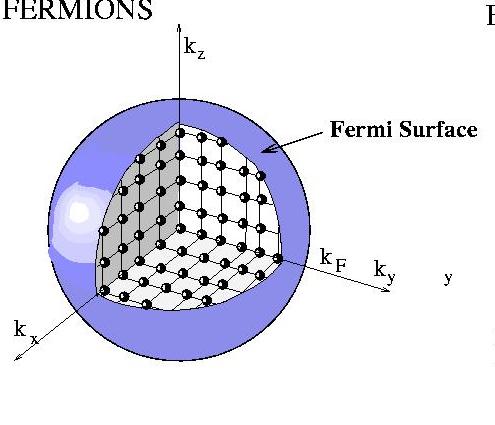
Maxwellian construction of a Fermi Surface |
Cuprate superconductor levitating a magnet. |
 |
 |
Quantum Critical Point: "Black hole" in the material phase diagram. |
Adiabatic concept: basis of perturbation theory. |
Instructor: Piers Coleman, Room 268
If you have any enquiries about this course or the
homework, please do not hesitate to contact me via email
at : coleman@physics.rutgers.edu
Scope of Course. Many body physics provides the
framework for understanding the collective behavior of
vast assemblies of interacting particles. This course
provides an introduction to this field, introducing you to
the main techniques and concepts, aiming to give you
first-hand experience in calculations and problem solving
using these methods.
Introduction to Many Body Physics.
The content of this course, with additional material will be my book "Introduction to Many Body Physics", published by Cambridge University Press and available on Amazon
 .
.
- Texts: Here are some other good references
for the course.
- Many-Particle Physics, Third Edition
by G. Mahan. (Plenum, 2000). A classic text on Many
body physics. Focuses on diagramatic and
Greens Functions method. Very thorough but a
little dated.
- Basic Notions in Condensed Matter Physics by P. W. Anderson. A classic reference. Many of us still turn to this book for inspiration, and philosophy. It also has a fine selection of important reprints at the back.
- ``Methods of Quantum Field Theory in Statistical Physics'' by Abrikosov, Gorkov and Dzyalozinskii. (Dover Paperback) - Classic text from the sixties, known usually as AGD.
- ``A guide to Feynman Diagrams in the
Many-Body problem by R. D. Mattuck. A light
introduction to the subject. Reprinted by Dover.
- ``Greens functions for Solid State Physics'' S.Doniach and E. H. Sondheimer. Not as thorough as AGD, but less threatening and somehow more manageable. Frontiers in Physics series no 44.
- ``Quantum Many Particle Systems'' by J. W. Negele and H. Orland. Alas all the good physics is in the unsolved excercises! However, it is the only one of this set to touch on the subject of functional integrals.
- R. Shankar, Rev Mod Phys 66 129 (1994). An amazingly self-contained review of the renormalization group and functional integral techniques written by one of the best expositors of condensed matter physics.
- ``Field Theories of Condensed Matter Physics'' by E. Fradkin. (Frontiers in Physics, Addison Wesley). Interesting material on the fractional statistics and the fractional quantum Hall effect.
- ``Quantum Field Theory in Condensed Matter Physics'' by A. Tsvelik. (Cambridge paper back) Very good for one dimensional systems. No exercises.
- The Theory of Quantum Liquids by D. Pines and P. Nozieres. Excellent introduction to Fermi liquid theory that avoids the use of field theory.
- Statistical Physics, vol II by Lifshitz and Pitaevskii. Pergammon. Marvellous book on applications of many body physics, mainly to condensed matter physics.
Traditional Many Body Theory and Greens Functions
Newer approaches to Many-Body Problem.
Further references:
Online
references (Check it
out- this is a great link).
Exercises 620 (Return to top)
Ex 1 Answers to Ex1
Ex 2 Answers to Ex2
Ex 3 Answers to Ex3
Ex 4 Answers to Ex4
Ex 5 Answers to Ex5
Ex 6
(Return to top) Note: this material is copywritten and should not be posted without permission.
12.10 pm on Monday and Thursday in Serin 287E. Thank you everyone for voting for this new time-slot. See: google_sheet. Occasionally, to make up for my travel, we will hold an additional class at a time we have to determine. I apologize for this inconvenience.
Office hour: 9:50am Tuesday or by arrangement. Tel x 9033
Assessment: Assessment will be made on the basis of weekly assignments, a take-home mid-term and a take-home final exam. I want to encourage an interactive class and will take this into account when grading!
(Return to top)
Outline We will make a selected sortie through
the following list. Asterisks indicate areas that will be
high priority
- Second Quantization. ``Free'' systems-- the building block of the quasiparticle concept. *
- Phonons and photons, Fermi and Bose fluids; spin-systems (x-y) model. Interactions.*
- Green's Functions and Feynman diagrams .*
- Finite temperature Green Functions. *
- Application of Finite temperature Feynman
Diagrams to (i) electron-phonon problem * ; (ii)
transport theory.
- Functional Integral Approach (if time permits).
- Broken Symmetry and Superconductivity. *
(Return to top)
Schedule (Currently in evolution - please check back for final schedule) :
Week |
Make-up class Probably on Weds Period 3, 12:10 |
Monday 12:10 Serin 287E |
Thu 12:10pm Serin 287E |
1. Sept 2-6 |
No Class: Labor Day. | Fields
overview. Einsteins phonon: the Simple Harmonic Oscillator |
|
2 Sept 9-13 |
Collective Quantum Fields: 1 and 3D | Collective Quantum Fields: continuum and thermodynamic limit. | |
3 Sept 16-Sept 20 |
Conserved
Particles: Canonical Commutation Rules |
Interactions | |
| 4 Sept 23-Sept 27 |
No Class: on Travel |
Particles in thermal equilibrium. | |
5 Sep 30- Oct 4 |
Examples
of 2nd Quantization 1 D Antiferromagnet. Hubbard Model |
Examples
of 2nd Quantization Jordan Wigner Transformation, 1D Ferromagnet. |
Examples
of 2nd Quantization Free Bosons, Fermions |
6. Oct 7- 11 |
Examples
of 2nd Quantization: Boltzmann Density Matrix |
No Class: on Travel | |
7. Oct 14 - 18 |
No
Class: on Travel |
Greens
Functions: Generating function for bosons |
|
8. Oct 21- 25 |
Adiabaticity Gell-Mann Low Theorem |
Greens
Functions: Free Fermions and Bosons |
Generating
function for Fermions. Spectral decomposition. |
9. Oct 28- Nov 1 |
T=0 Feynman diagrams: Heuristic derivation |
Landau
Fermi Liquid Theory |
T=0
Feynman Rules Linked Cluster Theorem |
10. Nov 4- 8 |
T=0 Electron in scattering potential. Hartree Fock. |
More Mr Feynman | |
11. Nov 11 - 15 |
Response functions. Lindhard Function. | RPA
Approach. Large N electron gas |
|
12. Nov 18 -Nov 22 |
Finite T Imaginary time Greens functions |
Finite
T Feynman Rules and examples |
|
13. Nov 25 - Nov 29 |
Finite
T Feynman Rules: Electron in a disordered potential |
Finite
T: Electron Phonon interaction: self energy; Migdal's theorem. Class is on Tuesday |
|
14. Dec 2 - Dec 6 |
Superconductivity BCS Theory I | Superconductivity BCS Theory II | |
| 15. Dec 9 -
Dec 13 |
Meissner Effect |
No Class |
(Return to top)