1) Open any image of interest...say the short exposure
of the Centaurus Cluster

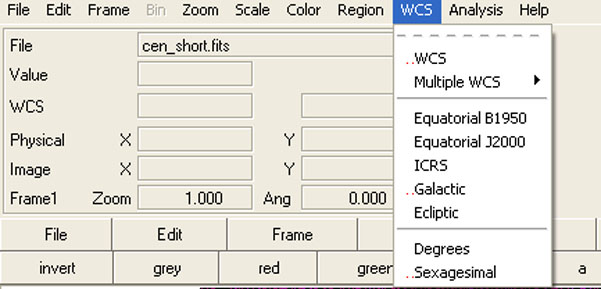
2) On the tool bar go to "WCS". Make sure there
are two red dots or a red check mark next to "WCS" and "galactic".
3) Move the cursor over the object and observe the
reading on the WCS display. Note the latitude and longitude.
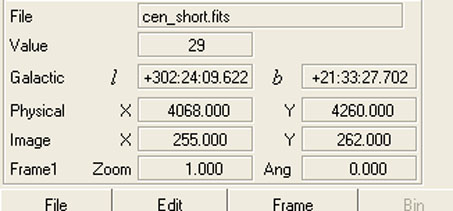
4) Now go to the Galactic Map and locate the Centaurus Cluster. What a coincidence, the Centaurus Cluster is in the middle of the Centaurus constellation!
1) Change the coordinate system to "Equatorial" as shown
below.

2) Place the cursor and find the coordinates of the
Centaurus Cluster in the display.

3) So now you see that the Centaurus cluster would be
about 41 degrees south of the Equator (the celestial one, right?
If you extended the equator of the Earth into the sky, you have defined
the celestial equator!) and in a position very close to the
autumnal equinox. Remember: alpha or Right Ascension is like
longitude, and zero degrees longitude is at the vernal equinox, in the
constellation of Aries. 12 hours RA is halfway around the
celestial sphere, where the Sun would be at September 20th, and is in
the constellation of Virgo. So, if you went to Virgo, and
looked about 41 degrees south, you would find the Centaurus cluster of
galaxies....
Now you can use Chandra to locate celestial objects in the sky relative to earth, and relative to the center of the galaxy.