Rutgers CMS Physics
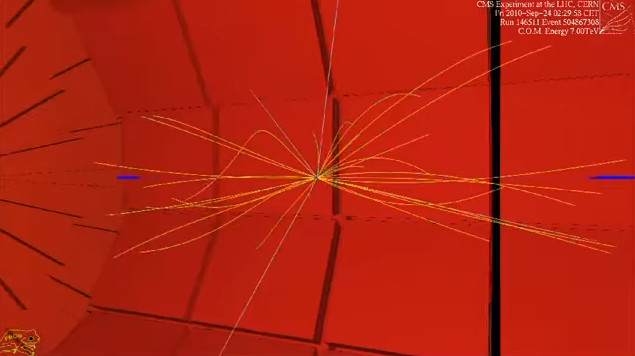 The Large Hadron Collider (LHC) at
CERN
promises to completely revolutionize current particle physics.
The LHC collides protons at a center of mass energy up to 14 TeV, seven
times higher than that of the Fermilab Tevatron Collider, and at a luminosity
more than ten times greater.
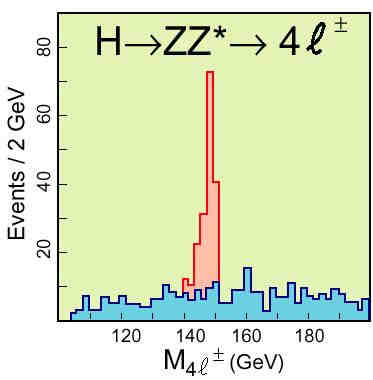
CMS discovered the Higgs Boson in 2012, the last missing ingredient of the
Standard Model.
Understanding the properties of the Higgs
will provide important information on the
Higgs mechanism that is believed to be the source of all mass.
The Large Hadron Collider (LHC) at
CERN
promises to completely revolutionize current particle physics.
The LHC collides protons at a center of mass energy up to 14 TeV, seven
times higher than that of the Fermilab Tevatron Collider, and at a luminosity
more than ten times greater.
CMS discovered the Higgs Boson in 2012, the last missing ingredient of the
Standard Model.
Understanding the properties of the Higgs
will provide important information on the
Higgs mechanism that is believed to be the source of all mass.
Most excitingly the LHC will likely yield discovery
of supersymmetry (SUSY) the ultimate symmetery of nature. The LHC should
provide the discovery of most of these supersymmetric partners leading
to a very extensive research program of sorting out their mass spectra
and branching ratios.
Experiments at the LHC may also address other more
exotic possiblities such as extra space-time dimensions.
The Compact Muon Spectrometer (CMS)
is one of two large
detector facilities built to do experiments at the LHC.
People involved in CMS:
Faculty:
Postdocs:
- Andrew Hart
- Kevin Nash
- Marc Osherson
- Halil Saka
PhD Student:
- Brandon Chiarito
- Steven Clark
- Maximilian Heindl
- Savvas Kyriacou
- Abhijith Gandrakota
- Hardik Routray
- Steffie Thayil
- Jay Vora
Undergrad Students:
- Duncan Adams
- Steven Chen
- Maine Christos
- Vishal Desai
- Rostyslav Ersteniuk
- Alison Feng
- Steven Ferrante
- Rikab Gambhir
- Ali Garabaglu
- Beatrice Gilman
- Brandon Gomes
- Bennett Greenberg
- David Jaroslawski
- Jacob Jastrzebski
- Rebecca Kowalski
- Pamela Pajarillo
- Noah Paladino
- Felipe Paucar-Velasquez
- Jacob Rothberg
- Anna Tsatsos
Staff:
Rutgers CMS Projects:
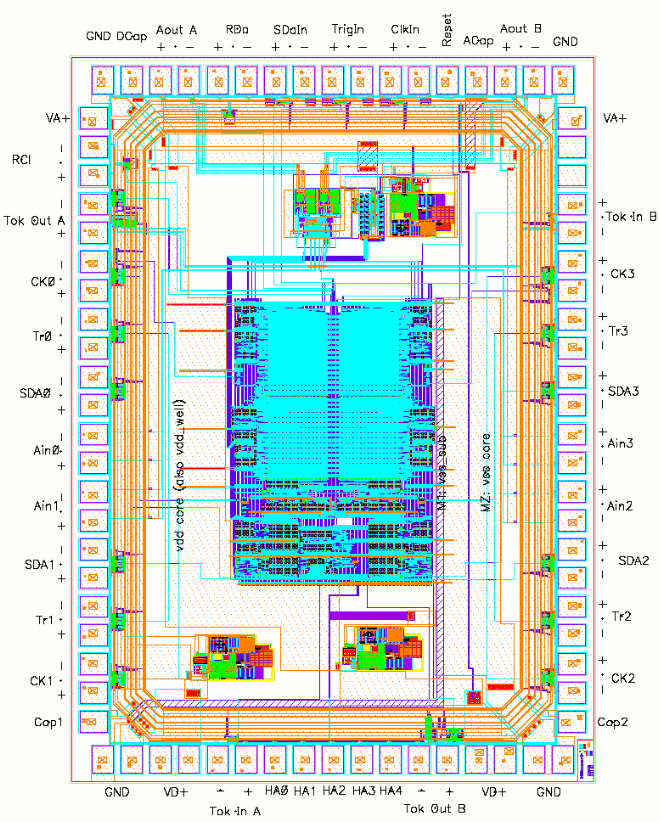
Token Bit Manager Chip
|
This is a custom-designed, radiation-hard IC that will orchestrate the
readout of the the pixel detector. The chip was designed at Rutgers
and has been fabricated in the IBM 0.25um process.
A TBM upgrade for CMS for the SuperLHC is currently being designed here.
|
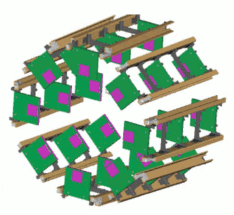
Pixel Luminosity Telescope
|
The PLT is a novel luminosity monitor for CMS using pixelated silicon
sensors to detect particle tracks. The pixels have the
same pattern and dimensions used in the CMS Pixel detector and
bumpbonded to a standard CMS Pixel readout ASIC. Rutgers designed and
lead the construction of this detector. Rutgers also
designed several custom ICs for this detector. It has been reliably
taking data since 2015 even though the sensors show signs of radiation
damage. The PLT is scheduled for a complete rebuild including new
sensors for the LHC restart in 2021.
|
All ASIC Design Work Done Using Cadence
Rutgers CMS Physics Analysis:
Rutgers physicists lead several analysis efforts, and have evaluated
in detail sensitivity to new physics with early
LHC data. Given our extensive Tevatron experience, our
strong point is realistic evaluations of
the Standard Model backgrounds, which leads to robust analyses
suitable for LHC startup. We also work closely with
Rutgers theorists
to develop search
strategies for new physics that could be missed
by standard search techniques.
Our analysis efforts include:
- New Physics Signatures with Jets
- New Physics Signatures with High Pt Photons
- New Physics Signatures with Multiple Leptons
Revised 12/7/2018