


Next: About this document
Physics 109: Homework #3 Solutions
- 3.1
- The Ptolemaic model of the solar system required epicycles
in order to account for the retrograde motion of the planets as well
as their change in apparent brightness. Copernicus included epicycles
just to account for the varying speeds of the planets as they move
through the sky.
- 3.2
- Yes, it is possible for a planet to have a synodic period
exactly equal to one year. It would need to be an inferior planet with
a sidereal period of exactly 1/2 year. A planet with a synodic period
a little more than a year could be either (1) an inferior planet with a
sidereal period of a little more than 1/2 year, or (2) a superior
planet with a very long sidereal period (like Neptune or Pluto).
- 3.3
- Kepler had already demonstrated that he was an accomplished
mathematician and astronomer in his work Mysterium
Cosmographicum (The Mystery of the Universe) which tried to
explain the spacing of the planets using the geometry of the five
regular solids (cube, tetrahedron, dodecahedron, icosahedron, and
octahedron). However in this work he also revealed that he was a true
believer in the Copernican or heliocentric model of the solar system,
which would have been a considerable weakness in his qualifications
from Tycho's point of view, who had his own model for how the solar
system was arranged.
- 3.4
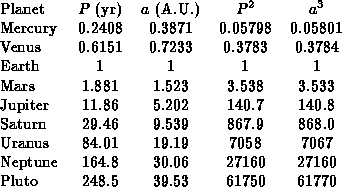
- The numerical agreement between the
 and the
  columns in the table below for each of the nine planets demonstrates
that
columns in the table below for each of the nine planets demonstrates
that  (Kepler's Third Law of Planetary Motion).
- 3.5
- The phases of Venus proved that Venus revolved around the
Sun. The moons of Jupiter showed that other celestial bodies could
have satellites and that the Earth was not the center of all motions
in the Universe. Stars remained point-like when viewed through the
telescope showing that they were much further away than Tycho and
other previous astronomers have believed. Sunspots and the mountains
on the Moon revealed that these bodies were not perfect but were
likely to be worlds like our own. The motion of sunspots across the Sun's
surface allowed Galileo to infer that the Sun was rotating, making it
that much easier to believe that the Earth itself rotated as well.
Next: About this document
John Hughes
Mon Oct 5 11:01:36 EDT 1998