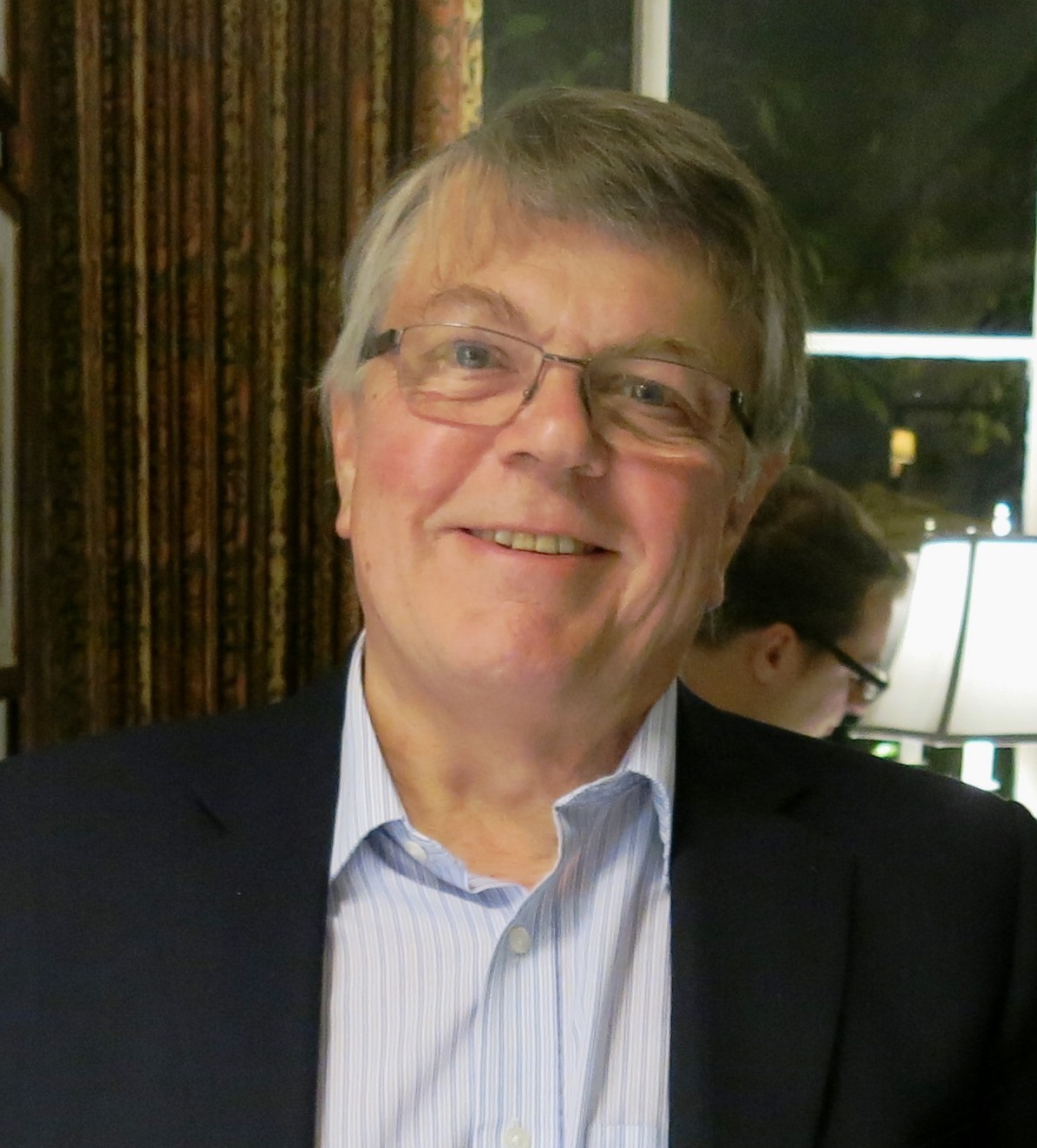
Jerry A. Sellwood
Full address and other contact information:
Department of Physics & Astronomy
Rutgers, The State University of New Jersey
136 Frelinghuysen Road
Piscataway, NJ 08854-8019
Telephone: (732) 445 5500, xtn 5287
Fax: (732) 445 4343
E-mail: sellwood_at_physics.rutgers.edu
Click for a CV, publication
list,
or for some biographical information.
Teaching
In the spring semester of 2009 I am teaching PH443/543: "Galaxies and
the Milky Way" - senior level undergraduate and introductory graduate
course. Click here for the class website.
Former graduate students are: Neil Raha,
David Earn,
Ben Weiner,
Victor Debattista,
Vince Jacobs and
Juntai Shen.
Current students are: Ricardo Zánmar Sánchez and Mike Solway.
Research Interests
Posted here is an electronic version,
with full quality figures, of "Dynamics of Barred Galaxies" by myself
and A. Wilkinson that appeared in Reports on Progress in
Physics (1993) 56, 173
My main interests are structure and evolution of galaxies, their
formation and their dark matter content. The following are some of
the topics I have been working on recently:
- Dark Matter The extended flat rotation curves of spiral
galaxies provide some of the strongest evidence for mass discrepancies
in galaxies, and are usually interpreted as evidence for dark matter
halos. My
research
suggests that dark matter halos have large low density cores,
i.e. most of the dark matter lies in the outskirts of galaxies
and that the inner parts of galaxies are dominated by the mass in the
stars. This point of view conflicts with Cold Dark Matter cosmology
which predicts high central densities for the halos. One idea to
resolve this conflict has been to suppose that the Dark Matter
particle has a low-enough mass that thermal velocities were
significant at the time galaxies form (the Warm Dark Matter model). I
show
that this idea seems to be ruled out, and that the Dark Matter
particle, if one exists, must have unusual properties.
- Spiral Structure Most disc galaxies display graceful
spiral patterns, yet over a century and a half, after their first
discovery, we still do not fully understand how they originate! My
view
is that the spirals are short-lived, recurring structures caused by
real instabilities. Some support for this point of view has recently
been obtained by the Hipparcos satellite, launched by ESA.
- Bar Stability About 30% of galaxies are strongly barred
and a roughly equal fraction are weakly barred, while the remaining
significant minority do not have bars. We do not yet understand the
reasons for these proportions. It has been suggested that galaxies
with less dark matter develop bars through a global instability, but
there is no evidence to support this speculation. My
work
suggests that whether a galaxy is barred or not today may depend on
the distribution of angular momentum in the material from which it
formed.
- Formation of massive Black Holes and QSO activity I
argue
that a bar must develop early in the life of nearly every galaxy and
that gas to create and fuel the QSO is driven into the center of the
galaxy by the bar. The QSO lifetime, and the mass of its central
engine, are also controlled by large-scale dynamics, since the fuel
supply is shut off after a short period by the development of an inner
Lindblad resonance. This resonance causes the gas inflow along the bar
to stall at a distance of a few hundred parsecs from the center. The
ILR develops as a result of previous inflow, making quasar activity
self-limiting. The bars are weakened and can be destroyed by the
central mass concentration formed in this way.
- Warps Many disk galaxies are not perfectly flat, but the
outer parts are bent away from the plane defined by the inner disk,
especially in the gas. Theoretical work suggests that this state of
affairs could not persist for the believed ages of galaxies and that
some mechanism is required to excite the warp continually (or
repeatedly). With my student, Juntai Shen, we
show
that realistic warps can be excited by late infalling matter having a
misaligned angular momentum vector. Our simulations manifested
realistic warps, and a series of simplified experiments allowed us to
understand the complex dynamical interaction of the disk and halo with
the externally applied torque. Furthermore, we were able to show that
the persistence of warps is not as puzzling as is widely believed;
halo damping of the warp is very weak since the inner halo remains
aligned with the slowly precessing disk and is only weakly coupled to
the outer halo. While these idealized experiments have not settled
all outstanding questions, they have shown that the problem may be
closer to a solution than is widely thought.
- Numerical Methods for N-body simulations I have
compared
five different methods for simulating galaxy models, which shows
that grid based (or particle-mesh) methods are superior in efficiency
to any other and are quite versatile. The combination of efficient
codes and quiet starts allows many galactic dynamical problems to be
tackled without the need for supercomputers.