|
HOME
RESEARCH PROJECTS
FACILITIES
GROUP MEMBERS
PUBLICATIONS
JOIN US
CONTACTS
|
Quantum Computing
with Nanoscale Josephson Junctions
We
have developed two novel Josephson circuits intended as prototypes of
protected qubits whose logical states are decoupled from the environment by
encoding them in a parity of a large number. The first type, the so-called
charge-pairing qubit [1], represents a chain of two Josephson elements
characterized by the π periodicity of the phase dependence of their
Josephson energy  (the so-called Josephson
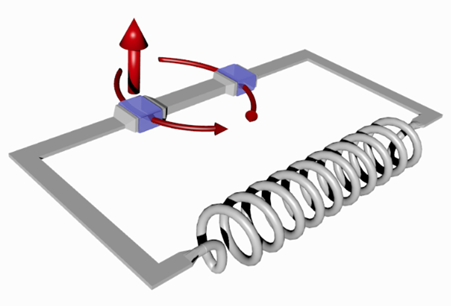
rhombi [2]). The second type, the flux-pairing qubit [3], consists of a
4π periodic (the so-called Josephson
rhombi [2]). The second type, the flux-pairing qubit [3], consists of a
4π periodic  Josephson element (a Cooper
pair box with the e charge on the
central island) shunted by a superinductor [4]. The lowest-energy quantum
states of the charge-pairing qubit are encoded in the parity of Cooper pairs
on a superconducting island flanked by the Josephson rhombi. The flux-pairing
qubit encodes its quantum states in the parity of magnetic flux quanta inside
a superconducting loop. Josephson element (a Cooper
pair box with the e charge on the
central island) shunted by a superinductor [4]. The lowest-energy quantum
states of the charge-pairing qubit are encoded in the parity of Cooper pairs
on a superconducting island flanked by the Josephson rhombi. The flux-pairing
qubit encodes its quantum states in the parity of magnetic flux quanta inside
a superconducting loop.
1. M.T. Bell, J.
Paramanandam, L.B. Ioffe, and M.E. Gershenson. Protected Josephson Rhombus
Chains. Phys. Rev. Lett. 112, 167001 1-5 (2014).
2.
S. Gladchenko, D. Olaya, E. Dupont-Ferrier,
B. Doucot, L.B. Ioffe, and
M.E. Gershenson. Superconducting Nanocircuits
for Topologically Protected Qubits. Nature Physics 5, 48-53 (2009).
3.
M.T.
Bell, W. Zhang, L. B. Ioffe, and M. E. Gershenson. Spectroscopic Evidence of
the Aharonov-Casher Effect in a Cooper Pair Box. Phys. Rev. Lett. 116,
107002 (2016).
4.
M.T.
Bell, I.A. Sadovskyy, L.B. Ioffe, A.Yu. Kitaev, and M.E.
Gershenson. Quantum Superinductor with Tunable Non-Linearity. Phys. Rev. Lett. 109, 137003 (2012).
|