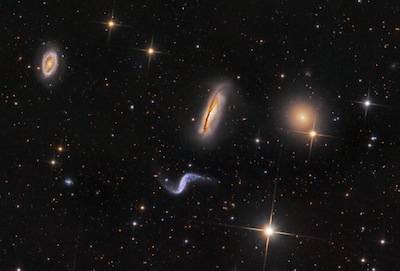
This course describes the properties of gravity, light, stars and galaxies, and the past, present and future of the Universe. There are no college-level prerequisites, but typical high school algebra and science preparation are assumed. The companion course, PHY109, covers the historical foundations of astronomy, the tools and techniques used by modern astronomers, the planets, moons, and minor bodies of our solar system, and the processes by which they formed. The two courses are independent; if you wish to take both, they can be taken in either order or concurrently.
Note that this course is intended for non-science majors. Students with two semesters each of physics and calculus should consider taking PHY341 and/or PHY342, instead. Those courses cover much of the same material as PHY110 and PHY109, but at a more advanced level.
More information about this course is available on our Canvas site (PHY110 Astronomy & Cosmology).
Prof. Eric Gawiser
Room 303, Serin Physics Building, Busch campus
Email: gawiser[at]rutgers.edu
Virtual office hours via Zoom: TBD
Communication: if possible, please use the email above instead of Canvas Inbox .
The textbook we will use is Astronomy from Openstax Access. It is free, online, and offers additional material including links to websites and videos. The course is tightly integrated with this textbook, including lectures, reading assignments, and in-class polls, so the textbook is required.
Synchronous lectures will be presented via Zoom at the scheduled times of W 9-10:20am and F 3-4:20pm. The lectures will feature slides and occasional videos and will be interactive via use of breakout rooms, polls, and real-time answering of questions posted in the chat. Lectures will be recorded to be (re-)viewed asynchronously.
Homework will be submitted via Canvas before each lecture and will consist of questions about the required textbook reading. We will also be doing in-class quizzes using Zoom polls, where each correct response is worth 2 points with other responses receiving 1 point for participation.
Completing the homework assignments is essential if you wish to get a good grade in the course. Doing the homework will prepare you for the exams: most of the exam questions will test the material covered in the homework.
The mid-term exam will be a collaborative effort of small groups but with each student receiving some individualized questions. The final exam format is TBD. There will be make-up exams for those who have an excused absence for either the midterm exam or the final exam. Only those people who are unable to attend the regular midterm or final exam because of a medical/family emergency (which must be documented with a dean's note), or other serious and unforeseen event (which must be documented with a dean's note) will be allowed to take the make-up exam.
Your final grade will be calculated from the homework (30%), midterm exam (25%), final exam (25%), and class participation including poll quizzes (20%). A final grade of 90% or higher will guarantee you an A for the class. It is impossible to get a good final grade without attending lectures, doing the textbook reading, and submitting the homework assignments.
Required: capability to view and listen to Zoom meetings and respond to Zoom polls, to type questions/comments in Zoom chat, and to view and provide input to Canvas.
Optional: capability to speak and send video via Zoom.
Resources:
Learning remotely is necessitated by the large size of this class and the ongoing pandemic, and it presents challenges. For assistance with learning
how to address these challenges, please consult the resources
available here.
Please visit the Rutgers Student Tech Guide
for resources available to all students. If you do not have the
appropriate technology for financial reasons, please email the Dean
of Students (deanofstudents@echo.rutgers.edu) for assistance.
If you are facing other financial hardships please visit the
Office of Financial Aid.
Students are expected to maintain the highest level of academic integrity. You must follow the university policy on academic integrity.
Use of external sources to obtain solutions to homework assignments or exams is cheating and is a violation of the University Academic Integrity policy. Cheating in the course may result in penalties ranging from a zero on an assignment to an F for the course to expulsion from the University. Posting of homework assignments, exams, recorded lectures, or other lecture materials to external sites without the permission of the instructor is a violation of copyright and constitutes a facilitation of dishonesty, which may result in the same penalties as explicit cheating.
Not only does the use of such sites violate the University's policy on Academic Integrity, using such sites interferes with your achievement of the learning you are paying tuition for. Assignments, quizzes, and exams are given not simply to assign grades, but to promote the active learning that occurs through completing assignments on your own. Getting the right answer is much less important than learning how to get the right answer. This learning is critical to your success in subsequent courses and your careers.
Almost all original work is the intellectual property of its authors. These works include syllabi, lecture slides, recorded lectures, homework problems, exams, and other materials, in either printed or electronic form. The authors hold copyrights in these works, which are protected by U.S. statutes. Copying this work or posting it online without the permission of the author violates the author's rights. More importantly, these works are the product of the author's efforts; respect for these efforts and for the author's intellectual property rights is an important value that members of the university community take seriously.
This syllabus may be modified as the semester progresses. The assignments are listed on the date they are due.
Lecture |
Date |
Topics |
Chapter |
Reading Assignment |
1 |
Sep 1 (Wed) |
course introduction |
||
2 |
Sep 3 (Fri) |
astronomy basics; review of algebra and scientific units
|
1 |
Ch. 1, Appendices A-E
|
3 |
Sep 10 (Fri) |
modern astronomy |
2 |
Ch. 2
|
4 |
Sep 15 (Wed) |
gravity; orbits |
3 |
Ch. 3 emphasizing 3.1-3.3
|
5 |
Sep 17 (Fri) |
seasons; moon phases; eclipses |
4 |
Ch. 4 |
6 |
Sep 22 (Wed) |
light |
5 |
Sections 5.1,5.2,5.3 |
7 |
Sep 24 (Fri) |
light |
5 |
Sections 5.4,5.5,5.6 |
8 |
Sep 29 (Wed) |
telescopes |
6 |
Ch. 6 emph. 6.1-6.3
|
9 |
Oct 1 (Fri) |
the Sun, our star |
15.1,16 |
Ch. 16 emph. 16.2,16.3 |
10 |
Oct 6 (Wed) |
starlight |
17 |
Ch. 17 emph. 17.1-17.3
|
11 |
Oct 8 (Fri) |
a census of stars
|
18 |
Ch. 18 emph. 18.2,18.4
|
12 |
Oct 13 (Wed) |
the cosmic distance ladder |
19 |
Ch 19 emph. 19.2-19.4
|
13 |
Oct 15 (Fri) |
gas and dust in galaxies |
20 |
Ch 20 emph. 20.1-20.3
|
14 |
Oct 20 (Wed) |
stellar birth; exoplanets |
21 |
Ch 21 emph. 21.1,21.4,21.5
|
15 |
Oct 22 (Fri) |
stellar evolution |
22 |
Ch 22 emph. 22.1-22.3 |
| 16 | Oct 27 (Wed) | midterm review | come with questions | |
exam |
Oct 29 (Fri) |
midterm exam, 3-4:20pm via Zoom |
covers Ch. 1-6,16-22 |
|
18 |
Nov 3 (Wed) |
exploding stars
|
23 |
Ch 23 emph. 23.1,23.2,23.5 |
19 |
Nov 5 (Fri) |
general relativity; black holes |
24 |
Ch 24 emph. 24.1,24.2,24.5
|
20 |
Nov 10 (Wed) |
our Milky Way galaxy |
25 |
Ch 25 emph. 25.1,25.3,25.4
|
21 |
Nov 12 (Fri) |
galaxies; the expanding universe |
26 |
Ch 26 emph. 26.1,26.2,26.4,26.5
|
22 |
Nov 17 (Wed) |
supermassive black holes |
27 |
Ch 27 emph. 27.1,27.2
|
23 |
Nov 19 (Fri) |
distant galaxies |
28 |
Sections 28.1,28.2,28.3
|
24 |
Nov 29 (Mon) |
dark matter; galaxy formation |
28 |
Sections 28.4,28.5
|
25 |
Dec 1 (Wed) |
the Big Bang
|
29 |
Sections 29.1,29.2,29.3
|
26 |
Dec 3 (Fri) |
the cosmic microwave background |
29 |
Sections 29.4,29.5,29.6,29.7
|
27 |
Dec 8 (Wed) |
life in the universe |
30 |
Ch 30 emph. 30.1,30.2,30.4
|
28 |
Dec 10 (Fri) |
final exam review |
come with questions
|
|
exam |
Dec 17 (Fri) |
final exam
4:00 to 5:30pm via Zoom |
covers Ch. 1-6,16-30, emph. Ch.23-30 |
Student wellness resources are available at Rutgers.
Students with disabilities should consult the department policy.
Astrophysics at Rutgers • Department of Physics and Astronomy • Rutgers University
Last updated: November 28, 2021 EG